"Before the Rooster Crowed" – Bird, Trumpet, or Hidden Signal of Denial?
The Familiar Prediction We Often Mishear
 Jesus looked straight at Peter and spoke words that must have pierced like a sword: "Truly I tell you, this very night, before the rooster crows twice, you will disown me three times" (Mark 14:30). The other Gospels record similar warnings: Matthew says "before the rooster crows" (Matthew 26:34), Luke says "the rooster will not crow this day" (Luke 22:34), and John omits the rooster entirely but records the prediction of denial (John 13:38).
To modern readers, this is simply a farmyard bird announcing dawn. But to first-century audiences in Jerusalem—living under Roman military occupation—the phrase "the rooster crowed" carried a different, immediate, and chilling cultural meaning. The Greek word ἀλέκτωρ (aléktōr) literally means "rooster," but in Roman-occupied Judea it was also the everyday term for the gallicinium—the Roman trumpet blast that ended the third night watch (around 3 a.m.) and signaled the beginning of the fourth watch. This military "cock-crow" was a daily sound in Jerusalem, especially near the Antonia Fortress overlooking the Temple courts. Ancient hearers would have instantly recognized the double meaning; modern readers usually miss it entirely.
Supporting evidence comes from Roman military practice (Josephus, Jewish War 5.2.5; Polybius 6.39), the Mishnah (Yoma 1:8, mentioning night watches), and early church fathers like Jerome and Augustine, who noted the trumpet interpretation. The phrase is thus a culturally embedded signal that layers Roman timekeeping and military presence onto Peter's failure, making the denial even more poignant in its historical setting.
"And immediately, while he was still speaking, the rooster crowed." — Luke 22:60 (AKJV)
Evidence and Arguments for the Trumpet Interpretation
The debate over whether "rooster crow" means a literal bird or a Roman trumpet has strong support on both sides, but the trumpet view resolves several textual and historical puzzles. Key points include:
- Roman Military Timekeeping: Jerusalem's night was divided into four Roman watches (6 p.m. to 6 a.m.), with the third ending at ~3 a.m. with a trumpet call called gallicinium ("cock-crow"). Soldiers stationed at the Antonia Fortress would have sounded this daily, audible across the city and Temple area. Ancient readers would have heard "the rooster crowed" and immediately pictured the watch change, a sound of Roman authority breaking the silence of the night.
- Gospel Variations: Mark uniquely says "before the rooster crows twice" (Mark 14:30), while others say once. A literal rooster might crow once or unpredictably, but Roman bugle calls were precise and repeated—fitting Mark's detail better and suggesting the military signal's double blast.
- Historical Context: Josephus describes Roman trumpet signals in Jerusalem (Jewish War 5.2.5), and the Mishnah references night watches with signals (Yoma 1:8). Early Christian writers (Jerome, Augustine) understood "cock-crow" as the military signal, not a farm bird in the city at night.
- Urban Setting: Peter's denial occurs in the high priest's courtyard near the Temple—urban, not rural. Roosters were uncommon in dense cities; Roman trumpets were not. The phrase thus carries the weight of Roman occupation and time discipline, reminding listeners of the empire's constant presence.
- Textual Clues: Luke says the rooster crowed "immediately, while he was still speaking" (Luke 22:60), suggesting a sudden, punctual event—not the gradual crowing of a bird. A trumpet blast fits perfectly as a sharp, authoritative sound.
- Absence in John: John omits the rooster entirely but includes the prediction (John 13:38). This may reflect John's theological focus on Jesus as the "light of the world" breaking through the darkness, rather than the military signal of the night watch.
- Theological Irony: Whether bird or trumpet, the "crow" marks Peter's threefold denial—fulfilling Jesus' prediction and amplifying the shame of betrayal just before dawn, the time of new beginnings and resurrection hope. The sound of Roman authority echoes in the background, yet Jesus' sovereignty stands above it all.
The Rooster in Jewish and Roman Symbolism
In Greco-Roman culture, the rooster was a symbol of vigilance, courage, and the breaking of dawn—often associated with the god Ares or Mercury. It was a common motif in military contexts, representing the watchman who signals danger or the end of night. In Jewish thought, the rooster appears in some rabbinic texts as a symbol of watchfulness, but it was not a dominant image in Temple or daily life.
The trumpet, however, was deeply symbolic in Jewish tradition: the shofar announced festivals, warned of danger, and called people to repentance (Joel 2:1; Leviticus 25:9). The Roman gallicinium trumpet thus created a powerful cultural collision—Roman imperial timekeeping overlaid onto Jewish sacred space. The "rooster crow" becomes a symbol of oppression meeting divine prophecy, with Peter's denial occurring under the very sound of empire.
This layering adds irony: the empire's signal of control marks the moment of human failure, yet it also heralds the coming dawn of resurrection. Jesus' words transcend both bird and trumpet—He is the true dawn-bringer, the light that breaks through every darkness (John 8:12).
Why This Interpretation Matters: Layers of Meaning and Modern Application
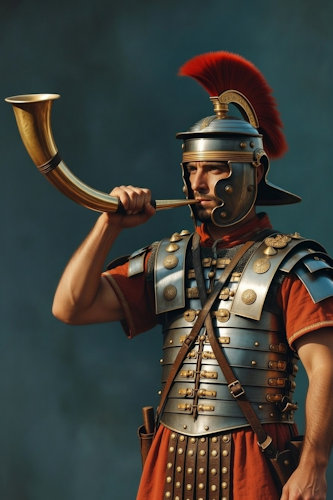 The "rooster crowed" phrase is not just a time marker—it's a layered detail that deepens the drama of Peter's denial and the passion narrative. For ancient hearers, it evoked the ever-present Roman military rhythm, reminding them of occupation, control, and the ever-present threat of imperial power. For us today, uncovering this hidden meaning restores the raw emotional force of the story.
Peter's failure happens under the shadow of empire—yet Jesus foreknew it, predicted it, and later restored him by another fire on the shore (John 21). The "crow" becomes a pivot point: the end of night watches, the beginning of daylight, and the turning point from denial to repentance. It underscores God's sovereignty even in human weakness, and grace that redeems failure.
This small cultural detail reminds us that Scripture is rich with layers—meanings ancient audiences grasped instantly, but which require patient study to recover today. When we dig into these details, the Bible becomes more vivid, more human, and more divine. Peter's story is not just about denial; it's about the grace that meets us at our lowest point and calls us back to feed His sheep.
Whether the "rooster" was a bird or a trumpet, the message remains: even our darkest failures are known to Christ, predicted by Him, and—through repentance—turned into opportunities for restoration. The sound that marked Peter's lowest moment also signaled the coming dawn—and the same is true for us. Grace turns the signal of failure into the announcement of new beginnings.