Drink to the Dregs: The Cup Jesus Drank and the Trade He Offers
The Request and the Rebuke
 As Jesus journeyed to Jerusalem, knowing His death was near, James and John (the "Sons of Thunder") approached Him with a bold request. In Matthew 20:20–28, their mother speaks: "Grant that these my two sons may sit, the one on thy right hand, and the other on the left, in thy kingdom." Mark's account has the brothers asking directly (Mark 10:35–45). They wanted positions of honor in what they assumed would be Jesus' earthly kingdom.
Jesus replied, "Ye know not what ye ask. Are ye able to drink of the cup that I shall drink of?" (Matthew 20:22). They confidently answered, "We are able." Jesus affirmed they would indeed drink His cup, but the seats were not His to assign. The other disciples were indignant, but Jesus taught that true greatness comes from serving, culminating in His own example: "The Son of man came not to be ministered unto, but to minister, and to give his life a ransom for many" (Matthew 20:28).
"And Jesus said unto them, Ye shall drink indeed of my cup... but to sit on my right hand, and on my left, is not mine to give." — Matthew 20:23 (AKJV)
The Cup: What Does It Mean?
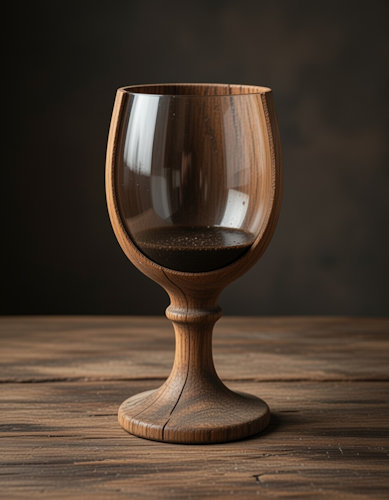
In the Bible, the image of drinking a cup is a powerful symbol for one’s destined portion in life — often suffering, judgment, or divine wrath. The phrase "drink to the dregs" means to consume the entire contents of a cup, including the very last drops at the bottom. The **dregs** are the thick, bitter, gritty sediment that settles at the bottom of wine or other drinks — the least desirable, most unpleasant part that most people leave behind. To drink to the dregs is to finish everything completely, even the bitterest, most difficult portion — something people in ancient times rarely did, because the dregs were considered unpalatable.
Jesus' cup was the full measure of God’s righteous wrath against sin — the concentrated judgment, suffering, and death that humanity deserved. In the Old Testament, God’s "cup of wrath" or "cup of His fury" is filled with punishment for rebellion (Isaiah 51:17; Jeremiah 25:15; Psalm 75:8). The dregs represent the strongest, most intense part of that judgment. Jesus knew He would drink this cup to its very bottom on the cross. In Gethsemane He prayed, “O my Father, if it be possible, let this cup pass from me: nevertheless not as I will, but as thou wilt” (Matthew 26:39).
Trading Cups: Wrath for Joy
Jesus drank the cup we deserved — the full measure of wrath, judgment, and death — to the very dregs. He took every bitter drop so we would never have to drink it. The cup we deserved was poison: divine anger, separation from God, and eternal death (Romans 6:23).
But the cup Jesus deserved was life, joy, celebration, and perfect communion with the Father. Through His sacrifice, He trades cups with us: He drinks our cup of wrath so we can drink His cup of blessing. This exchange is the heart of the gospel. In the Lord’s Supper, He offers us “the cup of blessing which we bless” (1 Corinthians 10:16; Psalm 116:13) — a cup of forgiveness, joy, and eternal life. As Isaiah prophesied, “He was wounded for our transgressions… the chastisement of our peace was upon him” (Isaiah 53:5).
"And he took the cup, and gave thanks, and gave it to them, saying, Drink ye all of it; For this is my blood of the new testament, which is shed for many for the remission of sins." — Matthew 26:27–28 (AKJV)
The Fate of James and John: Drinking the Cup
 Jesus’ words were prophetic. James became the first apostle martyred, beheaded by Herod Agrippa I around AD 44 (Acts 12:1–2). Tradition holds that Herod planned to crucify him, but James’ courage led the executioner to convert on the spot. James drank the cup of martyrdom, sharing in Christ’s suffering.
John outlived the others but endured great hardship. Exiled to Patmos under Emperor Domitian (AD 81–96), he faced hard labor in mines (Revelation 1:9). Early tradition (from Tertullian and others) says he was boiled in oil in Rome but miraculously survived. John drank the cup through persecution, exile, and witnessing the church’s trials, dying naturally around AD 100.
Lessons from the Cup for Us Today
The story of the cup teaches profound truths:
- We don’t always know what we ask: Like James and John, our prayers for blessing may invite suffering. God uses it to refine us (James 1:2–4).
- The exchange is our salvation: Jesus drank wrath so we drink joy. This is grace — unearned, undeserved (Ephesians 2:8–9).
- The Lord’s Supper reminds us: When we take communion, we remember the traded cup — His blood for our sins (1 Corinthians 11:25).
- Suffering is part of the call: Believers may share Christ’s cup of suffering, but it leads to glory (Romans 8:17).
- God prepares us: James and John weren’t ready then, but Jesus knew their future. He equips us for what He calls us to.
Jesus drank to the dregs so we don’t have to. The trade is made — wrath for joy, death for life. Will you accept His cup?