“I and My Father Are One” – Why the Jews Tried to Stone Jesus
The Argument: Jesus Never Said “I Am God” – But the Jews Heard It
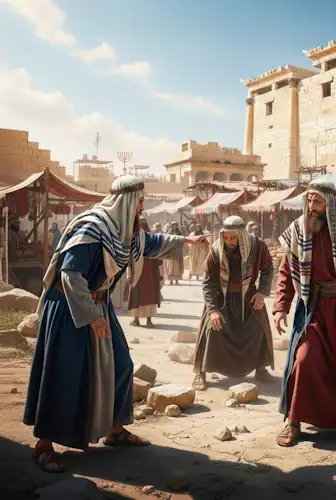 Some people argue that Jesus never explicitly claimed to be God. He called Himself the Son of Man, the Son of God, the Messiah — but He never said the words “I am God.” Yet the Jews who heard Him teach clearly understood His words as a claim to divinity. In John 10:33 they picked up stones to kill Him, saying: “For a good work we stone thee not; but for blasphemy; and because that thou, being a man, makest thyself God.”
This is the heart of the argument. Even though Jesus did not use those exact words, His teachings led His listeners — who were deeply rooted in Old Testament monotheism — to conclude He was claiming equality with God. The Jews understood “Son of God” not as a mere title, but as a declaration of sharing the same divine nature as the Father. That understanding connects directly to Old Testament prophecies of a divine Messiah and to Jesus’ own words throughout the Gospels.
The Jewish leaders did not react out of ignorance. They were experts in the Scriptures. They knew the Law, the Prophets, and the Writings by heart. When Jesus spoke, they recognized the implications immediately. Their reaction was not a misunderstanding — it was a precise recognition of what He was claiming. They accused Him of blasphemy because they believed He was making Himself equal with God. This moment in John 10 is one of the clearest examples in the Gospels of how Jesus’ words were heard and understood in His own time.
To grasp why they reached this conclusion, we must go back to the Old Testament foundations they held sacred. The Jewish people believed there is only one God. Any claim to divinity by a human would be unthinkable — unless the one making the claim was truly divine. That is exactly what they heard in Jesus’ words. Let’s walk through the key passages and connect all the dots.
“The Jews answered him, saying, For a good work we stone thee not; but for blasphemy; and because that thou, being a man, makest thyself God.” — John 10:33 (AKJV)
The Jews’ Reaction – John 10:30–33
In John 10, Jesus said: “I and my Father are one” (John 10:30). The Jews’ immediate response was to pick up stones. When Jesus asked why, they replied: “For blasphemy; and because that thou, being a man, makest thyself God” (John 10:33).
They did not misunderstand Him. They understood exactly what He was claiming. In Jewish theology, only God is God. Any human claiming to be equal with God was blaspheming. Jesus did not correct their understanding — instead, He affirmed it by quoting Psalm 82:6: “Is it not written in your law, I said, Ye are gods?” (John 10:34). He argued: if the Law calls human judges “gods,” how much more can the one consecrated by the Father call Himself the Son of God?
The Jews heard “Son of God” as a claim to divine nature — not just a royal title, but equality with God Himself. That is why they tried to stone Him. They knew the Law: “He that blasphemeth the name of the Lord, he shall surely be put to death” (Leviticus 24:16). They believed Jesus had crossed that line. Their reaction was not emotional overreach — it was a logical response to what they heard as a direct claim to divinity.
Jesus’ response did not deny the charge. He defended it. He pointed them back to Scripture and showed that His claim was consistent with God’s own words. The Jews understood the implication: if He is the Son in the way He claimed, then He shares the Father’s divine essence. That is blasphemy unless it is true.
Matthew 1 – “God with Us” from the Beginning
Matthew 1 makes the claim from the very beginning. The angel tells Joseph: “She shall bring forth a son, and thou shalt call his name Jesus: for he shall save his people from their sins” (Matthew 1:21). The name Jesus (Yeshua) means “Yahweh saves” — a clear claim that Jesus is Yahweh in action, the one who accomplishes salvation.
Matthew then quotes Isaiah 7:14: “Behold, a virgin shall be with child, and shall bring forth a son, and they shall call his name Emmanuel, which being interpreted is, God with us” (Matthew 1:23). From birth, Jesus is declared “God with us.” The Jews who heard Jesus teach understood this implication — He was claiming to be the fulfillment of Isaiah’s prophecy, the divine Son who is God among us.
The name Emmanuel is not just poetic. It is a theological statement. In the Old Testament, God’s presence with His people was always a sign of His covenant faithfulness. Now, in Jesus, God is personally present in human form. The Jews who accused Him of blasphemy understood this connection. When Jesus said “I and my Father are one,” they heard the same claim as “Emmanuel” — God with us, God in human flesh.
Old Testament Prophecies of a Divine Messiah
The Old Testament itself points to a Messiah who is divine:
- Isaiah 9:6: “For unto us a child is born… and his name shall be called Wonderful, Counsellor, The mighty God, The everlasting Father, The Prince of Peace” (Isaiah 9:6).
- Psalm 2:7,12: “Thou art my Son; this day have I begotten thee… Kiss the Son, lest he be angry” (Psalm 2:7; Psalm 2:12).
- Micah 5:2: “Whose goings forth have been from of old, from everlasting” (Micah 5:2).
- Isaiah 7:14: “Emmanuel” – God with us (Isaiah 7:14).
- Daniel 7:13-14: “One like the Son of man” coming with the clouds, receiving everlasting dominion (Daniel 7:13–14).
These prophecies show that the Messiah would be divine. The Jews who heard Jesus understood His claims in light of these texts. When He said “I and my Father are one,” they heard the same divine claim. The Old Testament prepared them to recognize it.
Jesus’ Other Claims to Divinity
Jesus made several statements that the Jews understood as divine claims:
- “Before Abraham was, I am” (John 8:58) — using the divine name “I AM” from Exodus 3:14. The Jews tried to stone Him immediately.
- “I am the resurrection and the life” (John 11:25) — only God gives life.
- “I am the way, the truth, and the life” (John 14:6) — claiming to be the exclusive path to the Father.
- “He that hath seen me hath seen the Father” (John 14:9) — direct equality with God.
- “I am the good shepherd” (John 10:11) — echoing Psalm 23:1 (“The Lord is my shepherd”).
Every time Jesus made these claims, the Jews understood them as divine — and reacted with attempts to kill Him for blasphemy. They knew what He was saying. The Old Testament had prepared them to recognize a divine Messiah. When Jesus spoke, they heard the voice of God Himself.
The Meaning for Us Today
 The stoning argument shows that Jesus’ contemporaries understood His claims as divine. He did not need to say “I am God” — His words and actions said it for Him. Genesis shows God’s plurality from the beginning. Matthew 1 calls Him “God with us.” The Old Testament prophesied a divine Messiah. Jesus fulfilled it.
The argument that Jesus never claimed divinity ignores how His listeners heard Him. The Jews understood “Son of God” as equality with God — and so should we. Jesus is the Son who is God. The evidence is in the text, in the reactions of those who heard Him, and in the fulfillment of the Old Testament promises.
This truth is not just historical — it is personal. Jesus, who is God, came to save us. He is not a distant deity or a created being. He is the eternal Son who became flesh, who lived among us, who died for us, and who rose again. The Jews who tried to stone Him understood what He was claiming. May we understand it too — and worship Him as Lord and God.