The Darkness and the Torn Veil: The Profound Meaning of Jesus’ Cry on the Cross
The Darkness That Covered the Land
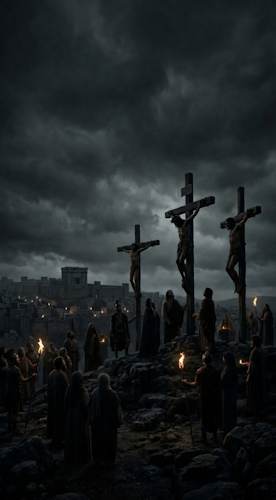 From the sixth hour to the ninth hour — noon until 3:00 p.m. — darkness covered the entire land while Jesus hung on the cross. This was not an ordinary eclipse or a natural phenomenon that could be explained away. It was a supernatural darkness that fell at the exact moment the Passover lambs were being slain in the temple. The Bible records it plainly: “And it was about the sixth hour, and there was a darkness over all the earth until the ninth hour” (Luke 23:44).
Historical records outside the Bible also mention this darkness. The Roman historian Thallus, writing around 52 AD, referred to a “most fearful darkness” that occurred during the reign of Tiberius, during which the sun was eclipsed. Julius Africanus, quoting Thallus, noted that the darkness could not have been a natural solar eclipse because the moon was full at Passover, making an eclipse astronomically impossible. This darkness was a divine sign, not a natural event.
Modern astronomy confirms this. NASA and other scientific sources have calculated that a natural solar eclipse was impossible on the day of the crucifixion because Passover always occurs at full moon, and solar eclipses can only happen at new moon. Some scholars propose April 3, AD 33 as a possible date for the crucifixion. On that date, there was indeed a lunar eclipse visible in the evening (a “blood moon”), but the biblical darkness occurred in the middle of the day from noon to 3 p.m. — the opposite of what a lunar eclipse would produce. The midday darkness was therefore supernatural, a divine act of God marking the moment the true Passover Lamb was slain.
The timing is significant. At the precise hour when the Passover lambs were being sacrificed in the temple, the true Lamb of God was dying on the cross. The darkness symbolized the judgment of God falling on sin. It was the moment the Father turned His face away from the Son so that He could turn His face toward us. Jesus cried out in agony for the first time on the cross: “My God, my God, why hast thou forsaken me?” (Matthew 27:46). This cry was not about physical pain — Jesus had endured scourging and crucifixion without crying out. It was the cry of separation from the Father’s presence, something Jesus had never experienced before.
This darkness was the Father laying the iniquity of us all on His Son. It was the moment the wrath of God against sin was poured out on the sinless Savior. The darkness was not random — it was the visible sign that the price for sin was being paid in full. Even the creation itself bore witness to the cosmic significance of what was happening at Calvary.
“And it was about the sixth hour, and there was a darkness over all the earth until the ninth hour.” — Luke 23:44 (AKJV)
The Veil in the Old Testament Temple
The veil in the temple was one of the most sacred and imposing features of the Old Testament tabernacle and later the temple in Jerusalem. It was a thick curtain, described as being four inches thick, woven of blue, purple, scarlet, and fine linen, embroidered with cherubim. It separated the Holy Place from the Most Holy Place (the Holy of Holies), where the presence of God dwelt above the mercy seat on the Ark of the Covenant.
Only the high priest could enter the Holy of Holies, and only once a year on the Day of Atonement (Yom Kippur). Even then, he entered with great fear and trembling, carrying the blood of the sacrifice to sprinkle on the mercy seat to atone for the sins of the people. The veil was a constant reminder that sin separated humanity from God’s holy presence. No one could approach God freely; access was restricted and dangerous.
The veil symbolized the barrier caused by sin. It was the physical expression of the spiritual reality that humanity was cut off from God because of rebellion. The high priest’s annual entry was a temporary measure, pointing forward to a greater sacrifice that would one day remove the barrier forever.
The Veil Torn from Top to Bottom
At the exact moment Jesus cried out and gave up His spirit, the veil in the temple was torn from top to bottom. The Bible records: “And, behold, the veil of the temple was rent in twain from the top to the bottom” (Matthew 27:51). This was not a small tear — the veil was massive, thick, and heavy. It was torn completely in two, from the top to the bottom, indicating that God Himself had done it. No human hand could have torn it from top to bottom.
The tearing of the veil was the direct result of Jesus’ finished work on the cross. When He cried “It is finished” (tetelestai), the debt of sin was paid in full. The barrier between God and man was removed. The veil that had kept people out of God’s presence was now opened by God’s own hand. Access to the Father was now free for all who come through Jesus.
The timing is significant. The veil was torn at the ninth hour (3:00 p.m.), the exact moment the Passover lambs were being slain in the temple. Jesus, the true Passover Lamb, died at the precise hour the sacrificial system pointed to. The tearing of the veil declared that the old system of animal sacrifices and restricted access was now obsolete. The way into the presence of God was now open through the blood of Christ.
The Full Meaning of the Torn Veil
The torn veil has multiple layers of meaning. First, it shows that Jesus’ death opened the way to God. No longer do we need a high priest or animal sacrifices. We can now come boldly to the throne of grace through Jesus Christ. The book of Hebrews explains this: “Having therefore, brethren, boldness to enter into the holiest by the blood of Jesus, by a new and living way, which he hath consecrated for us, through the veil, that is to say, his flesh” (Hebrews 10:19–20).
Second, the veil being torn from top to bottom shows that God initiated the action. It was not man opening the way to God; it was God opening the way to man. The initiative came from heaven, not from earth. This is the heart of the gospel — God reaching down to us in love.
Third, the torn veil signifies the end of the old covenant and the beginning of the new. The old system of restricted access and repeated sacrifices was finished. The new covenant, sealed with Jesus’ blood, now allows every believer to have direct access to the Father. The Holy of Holies is no longer a restricted room — it is open to all who come through Christ.
The torn veil is a powerful picture of reconciliation. The barrier caused by sin has been removed. The way to the Father is now open. This is why the centurion at the cross declared, “Truly this was the Son of God” (Matthew 27:54). The supernatural darkness and the torn veil were undeniable signs that something eternal had happened.
The Meaning for Us Today
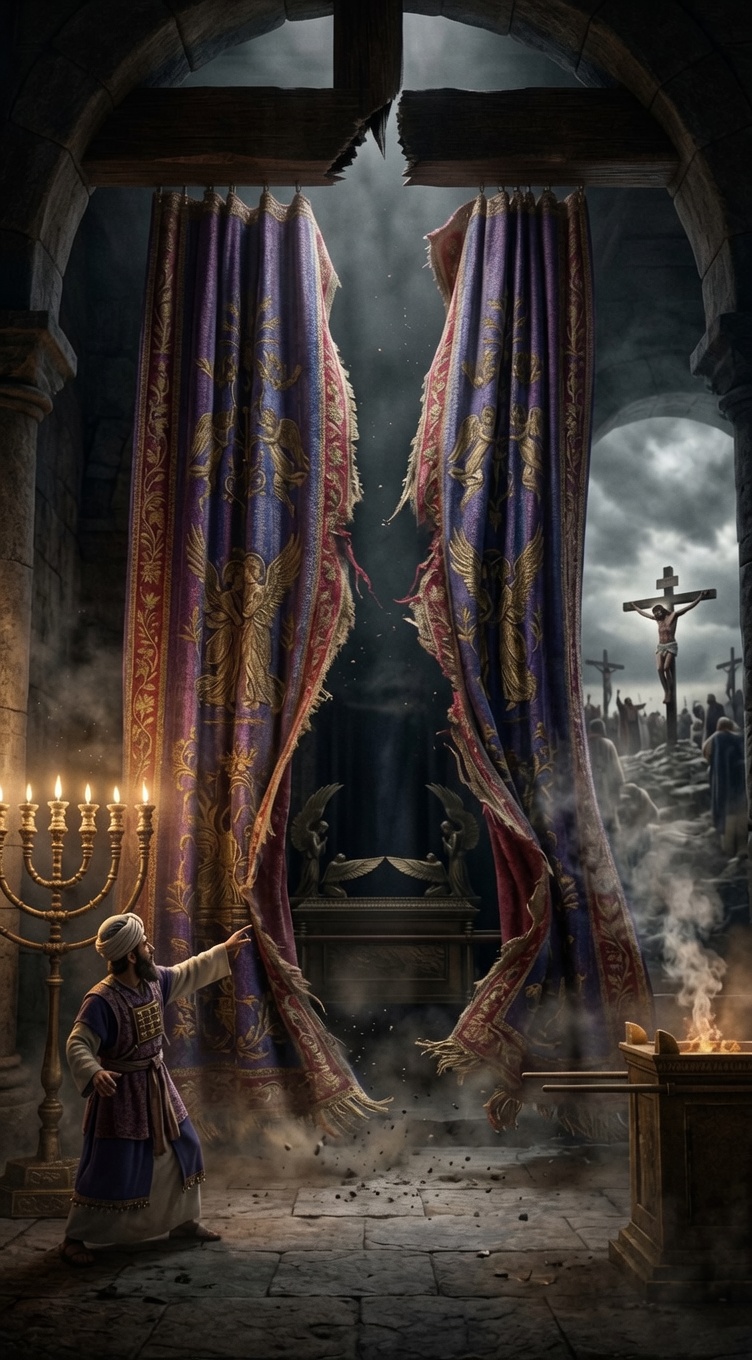 The torn veil is God’s invitation to come close. Because of Jesus’ death, we no longer need to stand outside. We can enter the presence of God with boldness and confidence. The darkness showed the judgment on sin. The torn veil shows the way to the Father is now open.
Today, we live in the reality of the torn veil. We do not need a priest or a temple building to approach God. We can come directly through Jesus Christ. The same power that tore the veil is available to us — the power that removes every barrier between us and God.
May we never take the torn veil for granted. It cost the life of the Son of God. It is our access to the Father, our assurance of forgiveness, and our hope for eternity. The darkness has passed, the veil is torn, and the way is open. Let us draw near to God with a true heart in full assurance of faith.