The Rich Young Ruler: What We Must Do to Inherit Eternal Life
A Man Who Ran to Jesus
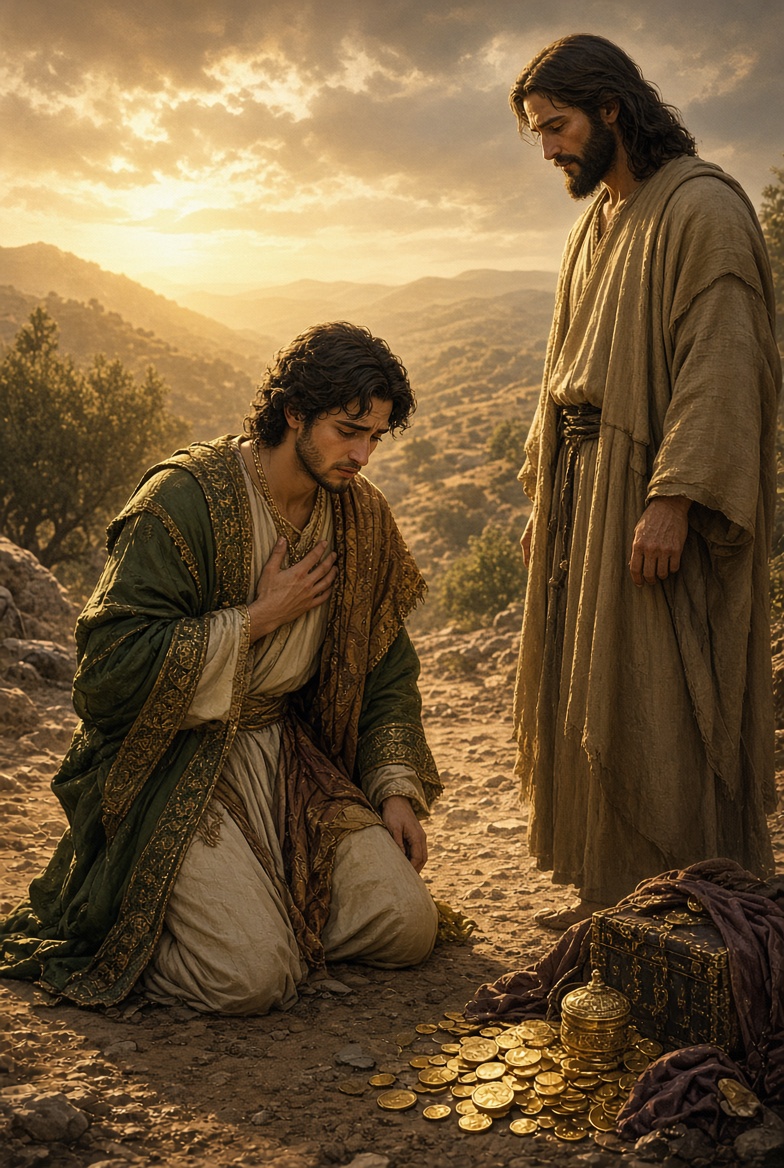 A man came running to Jesus, fell on his knees, and asked the question that still sits at the center of every human heart: “Good Teacher, what must I do to inherit eternal life?” (Mark 10:17 WEB). The Gospels never give him a name. Matthew calls him young. Luke calls him a ruler. All three note that he was rich. He arrived with urgency, respect, and an honest desire for eternal life. Jesus did not dismiss him. He looked at him and loved him.
The conversation that followed is one of the clearest places in the Gospels where Jesus puts the Ten Commandments in front of someone who thinks he has already kept them. The man did not ask for a new religion. He asked what he must do. Jesus answered by pointing him back to the commandments God had already given. The second table of the law, the commands that govern how we treat other people, became the measuring rod. The man believed he had measured up. Jesus showed him that he had not.
“Good Teacher, what shall I do that I may inherit eternal life?” — Mark 10:17 (WEB)
The Commandments Jesus Named
Jesus replied, “You know the commandments: ‘Do not murder,’ ‘Do not commit adultery,’ ‘Do not steal,’ ‘Do not give false testimony,’ ‘Do not defraud,’ ‘Honor your father and mother’” (Mark 10:19 WEB). These are the commands that protect life, marriage, property, truth, and the honor due to parents. In Mark’s account the list includes the distinctive phrase “Do not defraud,” which presses beyond mere theft into the way a person of means treats those who have less. The Ten Commandments are not a ladder a person climbs to earn eternal life. They are a mirror that shows the heart. The first four commands address how we relate to God. The remaining six address how we relate to one another. Jesus began with the second table, the place where most people feel confident they have done well.
The rich young ruler answered without hesitation: “Teacher, all these I have observed from my youth” (Mark 10:20 WEB). He had not murdered. He had not stolen. He had not committed adultery. He had honored his parents. By the external standard he had been taught, he stood clean. Jesus did not argue with the claim. He did not accuse the man of secret crimes. Instead He looked at him, loved him, and named the one thing that still stood between the man and the life he said he wanted.
The Ten Commandments expose what we love most. When a person can keep the visible rules while the heart remains attached to something else, the first commandment has already been broken. “You shall have no other gods before me” is not only about carved images. It is about whatever a person trusts, serves, and refuses to release. For this man the rival was his wealth. Jesus’ next words made that clear.
“You know the commandments: ‘Do not murder,’ ‘Do not commit adultery,’ ‘Do not steal,’ ‘Do not give false testimony,’ ‘Do not defraud,’ ‘Honor your father and mother.’” — Mark 10:19 (WEB)
The One Thing That Still Held Him
“One thing you lack,” Jesus said. “Go, sell whatever you have and give to the poor, and you will have treasure in heaven. Then come, follow me” (Mark 10:21 WEB). The command was not a general call to poverty. It was a specific diagnosis. The man’s wealth had become the place where his trust and his identity rested. Selling it and giving it away would free him to follow Jesus without a divided heart. Treasure in heaven was offered in place of treasure on earth. The invitation was to leave the old security and walk with the one who is truly good.
The man’s face fell. He went away grieved, for he had great possessions. He had asked what he must do. When the answer required him to release what he loved most, he discovered that he could not do it. The Ten Commandments had not failed him. They had done exactly what they were meant to do: they revealed that his heart was already claimed by something else. Jesus did not chase him. He let the man leave with the truth still ringing in his ears.
The disciples were astonished. If a man who kept the commandments and possessed great wealth could not enter, who could be saved? Jesus answered that with man it is impossible, but with God all things are possible. The story is not a warning against money. It is a warning against any rival that keeps a person from following the one who alone can give eternal life. The commandments show the need. Jesus meets the need. The rich young ruler saw both and still walked away.
“One thing you lack. Go, sell whatever you have, and give to the poor, and you will have treasure in heaven; and come, follow me, taking up the cross.” — Mark 10:21 (WEB)
A Side Note: The Man Who Wrote It Down
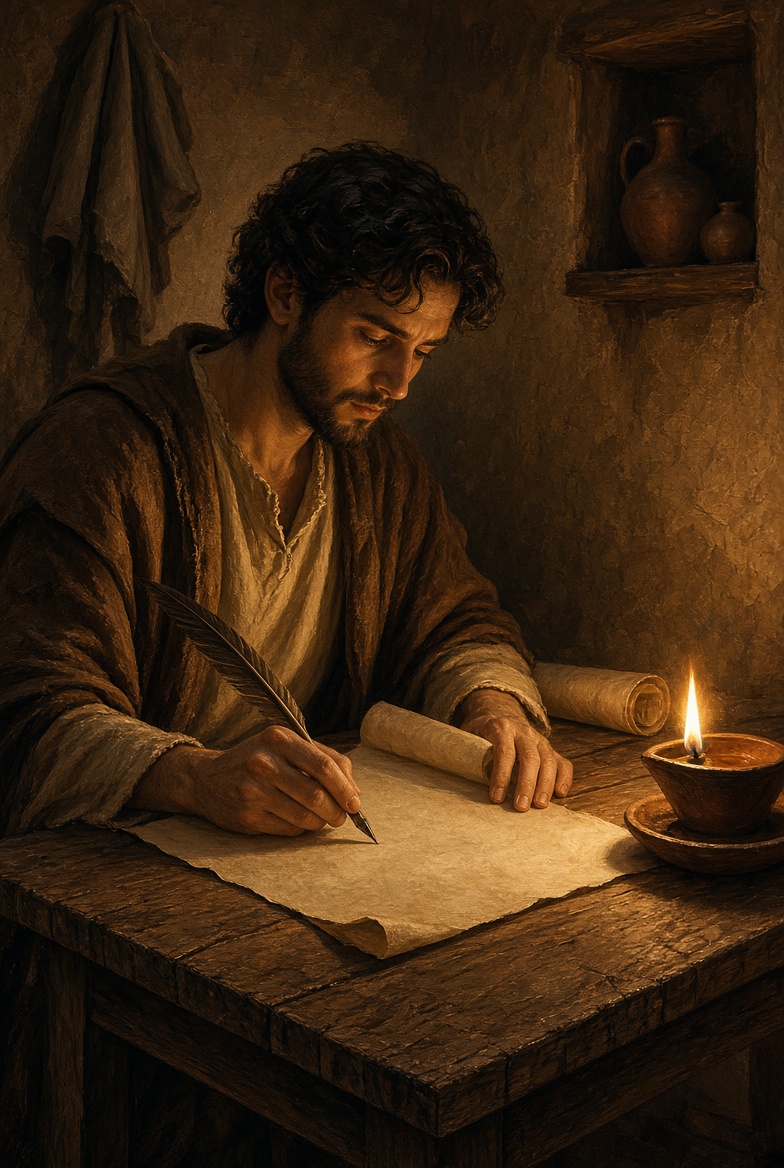 The account we have just walked through appears in the Gospel of Mark. Early church tradition holds that this Gospel was written by John Mark, the young man who appears in the book of Acts. Mark’s mother Mary owned a house in Jerusalem where the early believers gathered to pray (Acts 12:12 WEB). When Peter was released from prison he went straight to that house. John Mark later traveled with Paul and Barnabas, then with Barnabas alone after a sharp disagreement, and still later with Paul again. Peter himself called him “my son” (1 Peter 5:13 WEB).
The earliest clear statement that Mark wrote the Gospel comes from Papias, bishop of Hierapolis, writing in the early second century. Papias reported what he had heard from “the elder”: Mark became Peter’s interpreter and wrote down accurately what he remembered of the things said and done by the Lord. He had not been an eyewitness himself, but he carefully recorded the preaching of Peter. Later writers such as Irenaeus and Clement of Alexandria repeated the same tradition. The Gospel itself is anonymous, and modern scholars continue to debate the strength of the evidence. What the early church consistently taught is that the vivid, fast moving account we call Mark’s Gospel preserves the voice of Peter as it was heard and set down by John Mark.
Whether or not every detail of that tradition can be proved beyond question, the story of the rich young ruler reaches us through a man who once failed and was later restored. John Mark left Paul and Barnabas in the middle of the journey. Years later Paul asked for him again, saying he was useful for ministry. The same young man who once turned back is the one early Christians believed carefully wrote down the moment when another young man turned back from Jesus because of his wealth. The pattern is worth noticing: failure does not have the last word, and the truth still gets written down.
“She who is in Babylon, chosen together with you, greets you; and so does Mark, my son.” — 1 Peter 5:13 (WEB)
What the Commandments Still Do
The Ten Commandments remain the clearest statement of what God requires. They protect life, marriage, property, truth, and the honor of parents. They also expose every rival god. Most people can point to commandments they have not broken in obvious ways. Fewer people can look at the first commandment and say without hesitation that nothing else holds their trust. The rich young ruler could list the second table. He could not release the thing that had become his security. Jesus did not lower the standard. He raised it until the man’s true loyalty became visible.
The same diagnostic still works. When a person is asked what must be surrendered in order to follow Jesus, the answer that rises in the heart shows what has been sitting on the throne. It may be money. It may be reputation, comfort, a relationship, or the right to run one’s own life. The commandments do not condemn for the sake of condemnation. They reveal the need so that the invitation can be heard clearly: “Come, follow me.” The rich young ruler heard both the diagnosis and the invitation. He chose the diagnosis he already knew and left the invitation behind.
Jesus’ love for the man did not disappear when the man walked away. The look of love and the call to follow stood together. The same love still meets anyone who discovers that the commandments have named a rival they did not want to see. The way forward is not to pretend the commandments are lighter than they are. The way forward is to bring the exposed heart to the one who already knows it and who still says, “Come, follow me.”
The Question That Remains
The rich young ruler asked what he must do to inherit eternal life. Jesus pointed him to the commandments he already knew and then to the one thing those commandments had not yet touched. The man went away sorrowful. The story ends there in the text, but the question does not. Every reader is left with the same choice the man faced: whether the thing currently held most tightly will be released so that Jesus can be followed without reserve.
The Ten Commandments still stand as the clear standard. They show both the life God intends and the places where every heart falls short. The Gospel of Mark, whatever the precise path by which it reached us, preserves the moment when Jesus looked at a sincere, wealthy, commandment keeping man and loved him enough to tell him the truth. The same truth still meets anyone who runs to Jesus with the same question. One thing is always lacking until the heart is free to follow. The invitation remains open. The choice remains ours.