The Sacred Tenth: Trusting God with the First Fruits
What Is Tithing?
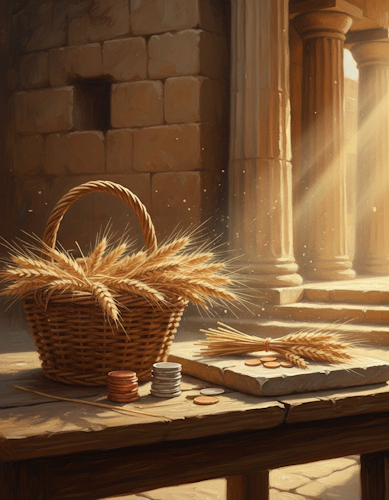 Tithing is the biblical practice of giving 10% of one’s income or produce back to God. The word “tithe” literally means “tenth” in Hebrew. It appears early in Scripture, even before the Law of Moses. Abraham gave a tenth of his spoils to Melchizedek, the priest-king (Genesis 14:18–20), and Jacob vowed a tenth to God at Bethel (Genesis 28:20–22).
Under the Mosaic Law, tithing became formalized. The Israelites were commanded to give a tenth of their crops, herds, and flocks to support the Levites, the temple, and the poor (Leviticus 27:30–32; Deuteronomy 14:22–29). There were actually multiple tithes: the Levitical tithe, the festival tithe, and the poor tithe, adding up to about 23% annually. But the core idea was the “first tenth” belonged to God.
Tithing was not just about giving — it was about acknowledging that everything comes from God and belongs to Him. It was a way to honor God as the source of provision and to trust Him for the remaining 90%. In the New Testament, Jesus affirmed tithing while emphasizing justice, mercy, and faith (Matthew 23:23). The principle of generous, cheerful giving carries forward (2 Corinthians 9:6–7).
“Bring ye all the tithes into the storehouse, that there may be meat in mine house, and prove me now herewith, saith the Lord of hosts, if I will not open you the windows of heaven, and pour you out a blessing, that there shall not be room enough to receive it.” — Malachi 3:10 (AKJV)
The Significance of the Number 10
The number 10 holds deep symbolic meaning in Scripture. It represents completeness, divine order, and human responsibility. There are 10 Commandments, the foundation of God’s moral law (Exodus 20:1–17). There were 10 plagues on Egypt, showing God’s complete judgment on idolatry (Exodus 7–12). Jesus used 10 virgins in a parable to teach readiness (Matthew 25:1–13) and 10 lepers to illustrate gratitude (Luke 17:11–19).
In tithing, 10 signifies that the whole (100%) belongs to God, but He asks for the first 10% as an act of faith and acknowledgment. It is a test of stewardship: can we trust God with the part so He can bless the whole? The number 10 reminds us that God’s provision is complete, and our giving is a response to His faithfulness. Ten is the number of testing and responsibility — it asks: “Will you honor Me with what is Mine?”
Tithing as a Test of Faith
Tithing is often presented as a test. In Malachi 3:10, God says: “Bring ye all the tithes into the storehouse… and prove me now herewith, saith the Lord of hosts, if I will not open you the windows of heaven, and pour you out a blessing, that there shall not be room enough to receive it.” This is the only place in Scripture where God invites us to “test” or “prove” Him.
The test is not for God’s benefit — He owns everything (Psalm 24:1). It is for ours. Tithing tests our faith: do we believe God will provide? It tests our priorities: is God first? It tests our heart: do we hold loosely to money? Like Abraham’s test with Isaac (Genesis 22:1–18), tithing reveals where our true treasure lies (Matthew 6:21).
In the New Testament, Jesus praises the widow’s mite — not because of the amount, but because it was all she had (Mark 12:41–44). The test is sacrifice, not size. Tithing is a starting point for that sacrifice. It asks: “Do you trust Me enough to give the first 10%, even when it feels like you can’t afford it?”
The Rewards of Tithing
God promises rewards for faithful tithing. In Malachi 3:10–12, He vows to “open the windows of heaven” and pour out blessings so great there “shall not be room enough to receive it.” He will rebuke the devourer (pests, loss, waste) and make the land fruitful. The rewards are both spiritual and material: protection, provision, prosperity, and favor. The devourer is rebuked — meaning God actively defends what you have left after giving.
In the New Testament, the principle expands. “Give, and it shall be given unto you; good measure, pressed down, and shaken together, and running over” (Luke 6:38). Paul promises that God will supply all needs for those who give generously (Philippians 4:19). The reward is not wealth for wealth’s sake, but abundance to bless others and advance God’s kingdom. Jesus said the one who gives up everything for Him receives a hundredfold in this life and eternal life in the age to come (Mark 10:29–30).
Ultimately, the greatest reward is a closer relationship with God. Tithing declares dependence on Him and invites His involvement in our finances. It breaks the power of greed and opens the door to joy in giving (Acts 20:35). It is worship in action — giving back to the One who gave everything to us.
Tithing in the New Testament – Grace or Law?
Is tithing required today? The New Testament does not command it as law, but the principle remains. Jesus affirmed tithing (Matthew 23:23), but emphasized justice, mercy, and faith. Paul teaches proportionate, cheerful giving (2 Corinthians 9:7). For many, 10% is a starting point, but grace giving may exceed it.
Tithing under grace is not legalism — it is worship. It is a joyful response to God’s generosity, trusting Him to multiply what we give. Whether 10% or more, the key is faith, not formula. The New Testament shifts the focus from obligation to heart — but the heart that honors God with the first fruits still sees His blessing.
Practical Steps for Tithing Today
To start tithing:
- Calculate: Determine 10% of your income (gross or net — pray about it).
- Give First: Tithe before other expenses (Proverbs 3:9).
- Give Faithfully: Make it regular, not sporadic.
- Give Joyfully: “God loveth a cheerful giver” (2 Corinthians 9:7).
- Expect Blessing: Not always financial, but always spiritual.
Tithing is a step of faith. Start small if needed, but start. Watch God prove Himself faithful. The number 10 is not magic — it is a symbol of trust. The test is real. The rewards are promised. The question is: will you give God the first 10% and let Him handle the rest?
The Invitation Today
 Tithing is more than money — it is faith in action. The number 10 reminds us of God’s complete provision. The test invites us to prove Him. The rewards show His generosity. Will you take the step? Trust God with the tenth, and watch Him bless the whole.
As Jesus said, “Give, and it shall be given unto you” (Luke 6:38). The God who owns the cattle on a thousand hills (Psalm 50:10) is waiting to pour out blessings. Begin today, and see what He does.