The Three Ages of Humanity: Understanding the End Times Through Jesus’ Teaching in Luke 21 and Matthew 24
The Timeline of Human History
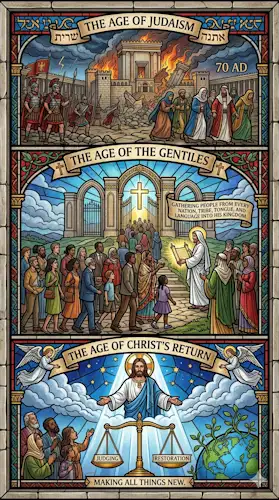 Jesus taught that human history is divided into three distinct ages. The first age was the Age of Judaism, which ended with the destruction of the temple in Jerusalem in 70 AD. The second age is the current Age of the Gentiles, the time in which we live, when God is gathering people from every nation, tribe, tongue, and language into His kingdom. The third age is the age of Christ’s return, when He will come back in power and glory to judge the living and the dead and make all things new.
This framework comes directly from Jesus’ own teaching in Luke 21 and Matthew 24. It is not a modern invention but the clear outline Jesus gave His disciples when they asked about the signs of His coming and the end of the age. Understanding these three ages helps us make sense of where we are in God’s redemptive plan and how we should live in light of His soon return.
The first age, the Age of Judaism, was the time when God worked primarily through the nation of Israel, the temple system, the sacrificial system, and the Old Covenant. It pointed forward to the coming of the Messiah. Jesus predicted its end in detail. He said the temple would be destroyed, not one stone left upon another, Jerusalem would be surrounded by armies, there would be great distress, and the Jewish people would be scattered among the nations. All of this happened exactly as He said in 70 AD when the Roman general Titus besieged Jerusalem, starved the city, destroyed the temple, and scattered the Jewish people. This marked the end of the old sacrificial system and the beginning of the new era.
The transition from the first age to the second was dramatic and final. The destruction of the temple in 70 AD was not just a political event; it was the fulfillment of Jesus’ prophecy and the closing of the old covenant system. No longer would animal sacrifices be offered. No longer would the high priest enter the Holy of Holies once a year. The old way was finished, and the new way — the way of grace through Jesus Christ — had begun. This shift opened the door for the gospel to go to the Gentiles, fulfilling the promise that all nations would be blessed through Abraham’s seed. The Age of Judaism had served its divine purpose: to prepare the world for the coming of the Messiah and to demonstrate humanity’s inability to earn righteousness through the law. With the temple gone, the focus of God’s redemptive work moved from one nation to every nation.
In the Old Testament, the temple stood as the visible symbol of God’s presence among His people. It was the place where heaven and earth met, where mediators interceded, and where blood was shed for the forgiveness of sin. Everything in that system — the priesthood, the sacrifices, the feasts, the Holy of Holies — was a shadow pointing forward to the substance that would come in Jesus Christ. When the temple was destroyed exactly as Jesus foretold, it signaled that the shadow had given way to the reality. The old covenant had been fulfilled and superseded by the new covenant in His blood. This was not the end of God’s plan; it was the beginning of a greater, wider work that would encompass every people group on earth.
“And it was about the sixth hour, and there was a darkness over all the earth until the ninth hour.” — Luke 23:44 (AKJV)
The Current Age of the Gentiles
We are now living in the second age, the Age of the Gentiles. This is the time when God is calling people from every nation, tribe, tongue, and language to be part of His kingdom. It is the age of the church, the age of global missions, the age when the gospel is going to the ends of the earth. Jesus said this age would continue until the gospel is preached to all nations as a testimony, and then the end would come (Matthew 24:14).
This age is characterized by both incredible opportunity and increasing difficulty. On one hand, millions are coming to faith every year, especially in places like Africa, Asia, and the Middle East. On the other hand, the signs Jesus described are intensifying: deception, wars, famines, earthquakes, persecution, and apostasy. These are the birth pains that signal the coming of the end. They are not the end itself, but they are increasing in intensity, just as contractions do before birth.
The purpose of this age is clear: God is patiently waiting so that more people can come to repentance. He is not slow; He is merciful. Every day that passes is another day for the gospel to reach more hearts. The church’s mission in this age is to make disciples of all nations, baptizing them and teaching them to obey everything Jesus commanded.
This age began at Pentecost when the Holy Spirit was poured out and the church was born. It has continued for nearly 2,000 years. During this time, the gospel has spread to every continent. Billions have heard the name of Jesus. Yet the task is not finished. There are still people groups who have never heard the gospel. The Great Commission remains our marching orders until Jesus returns.
In this age, the barrier that once separated Jew and Gentile has been broken down. The mystery that was hidden for ages is now revealed: Gentiles are fellow heirs, members of the same body, and sharers in the promise in Christ Jesus through the gospel. The Old Testament sacrificial system, the temple, the priesthood — all of it was a shadow. Jesus is the substance. He is the true temple, the perfect high priest, and the once-for-all sacrifice. In Him, people from every ethnicity are reconciled to God and to one another, becoming one new man in Christ.
The Signs of the End of the Age
Jesus gave four major signs that will mark the end of the Age of the Gentiles:
- Global Deception: Many will come in Jesus’ name saying “I am the Christ” and will deceive many. False prophets and false messiahs will perform signs and wonders, even possibly through demonic power. Believers must test everything against Scripture to avoid being deceived.
- Global Chaos: Wars and rumors of wars, famines, earthquakes, and other disasters will increase like birth pains. These are not the end, but they signal that the end is drawing near.
- Global Persecution: Believers will be hated by all nations for the sake of Jesus’ name. There will be increasing hostility, arrest, and martyrdom. In many parts of the world, Christians are already facing severe persecution.
- Global Apostasy: Many will fall away from the faith. False prophets will lead people astray, and even those who once professed faith will turn away. This apostasy will be fueled by persecution and the rise of a false religious system.
These signs are not meant to scare us but to prepare us. Jesus told us these things in advance so we would not be surprised. The church must be awake, discerning, and faithful in the midst of these challenges. The signs serve as reminders that the present age is temporary and that history is moving toward its appointed climax.
The Coming of the Third Age
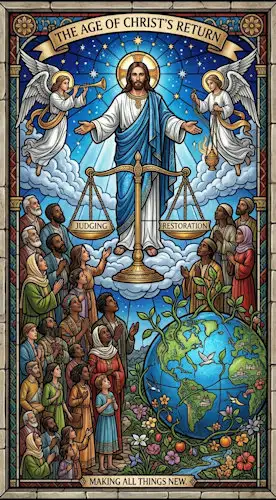 The third age is the age of Christ’s return. Jesus will come back visibly, in power and great glory. Every eye will see Him. He will judge the living and the dead. He will make all things new. There will be no more death, no more pain, no more tears. The kingdom of this world will become the kingdom of our Lord and of His Christ, and He will reign forever.
Between the current age and the third age, there will be a time of great tribulation. The signs will intensify. The false religious system will rise. Persecution will reach its peak. But in the midst of it all, the gospel will continue to go out, and a great multitude from every nation will be saved.
The church’s role is to be ready. We are to watch, pray, and work while it is day. We are to make disciples, plant churches, support missions, and live holy lives. We are to be salt and light in a darkening world. The end is not yet, but it is coming. Our job is to be faithful until He returns. This final age will usher in the visible, physical reign of Christ on the earth, fulfilling every promise of the prophets and bringing to completion the redemption of creation itself.
The Call to Readiness
Jesus’ teaching in Luke 21 and Matthew 24 is not given to satisfy curiosity about the future. It is given to prepare us for the present. We are to live with urgency, knowing that history is moving toward its climax. We are to live with hope, knowing that Christ is coming back. We are to live with faithfulness, knowing that our labor in the Lord is not in vain.
The signs of the times call us to vigilance. We must be watchful, prayerful, and actively engaged in the work of the kingdom. This is the age in which the gospel must reach every people group before the end comes. Every believer is called to live as though the return of Christ could happen at any moment, because the transition to the third age will be sudden and unmistakable. The present age is the time of opportunity; the third age is the time of consummation. Between them lies a period of unparalleled trouble, yet also the greatest harvest the world has ever seen.
The question for each of us is this: Are you ready? Are you living as though Christ could return at any moment? Are you investing your life in things that will last for eternity? The fishermen left their nets and followed Jesus immediately. Will you do the same? The three ages remind us that time is not endless. The Age of Judaism has passed. The Age of the Gentiles is drawing to a close. The age of Christ’s return is approaching. Let us therefore live with holy urgency, faithful obedience, and joyful expectation.