The Two Jesuses at Calvary: How Barabbas Reveals the Heart of the Atonement
The Ancient Ritual That Pointed to the Cross
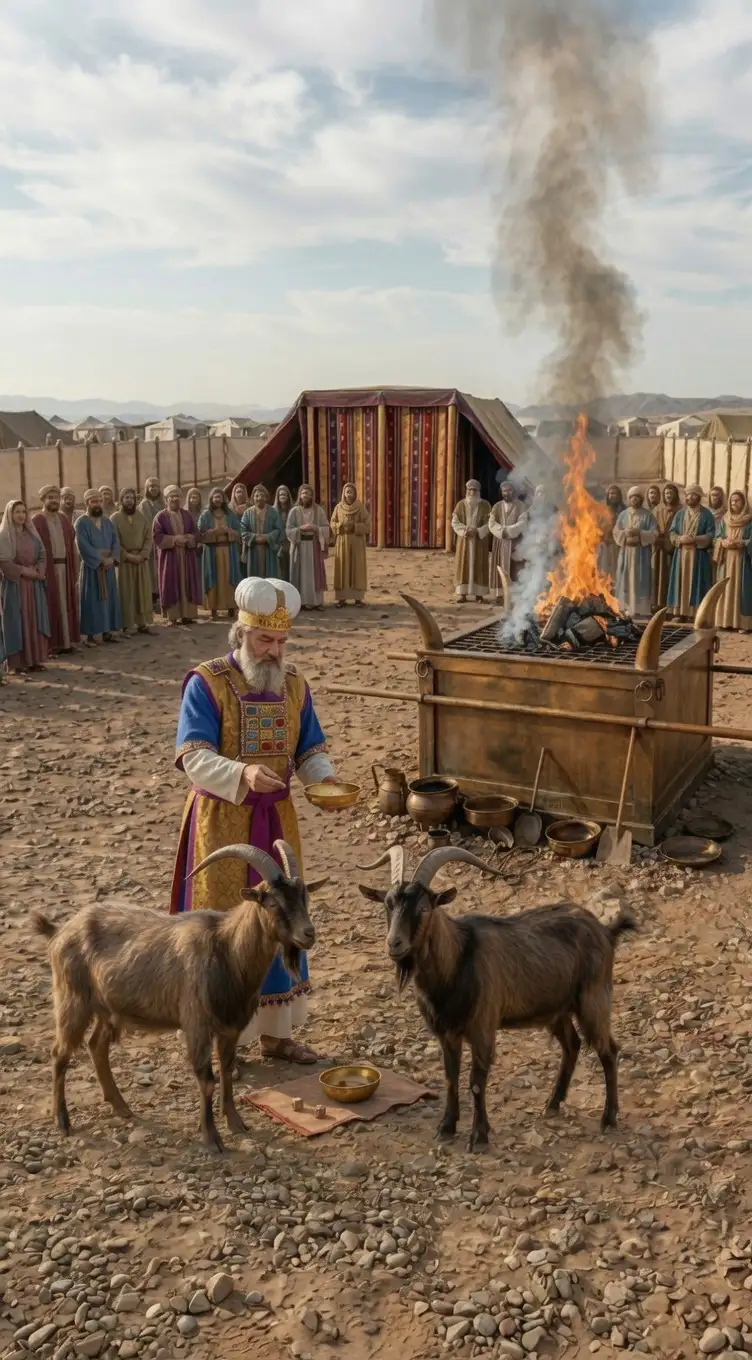 Every year on the Day of Atonement, the high priest of Israel stood before two identical goats. One would be slaughtered as a sin offering. The other would be sent alive into the wilderness, carrying the sins of the entire nation on its head. This was not a random tradition. It was a divinely ordained picture of how God would one day deal with the sin of the world.
The ritual was detailed and solemn. The high priest would cast lots to determine which goat was for the Lord and which was the scapegoat. The people watched as one animal died and the other was led away. They understood that their sins were being removed — some through blood, some through removal. Both goats together told the full story of atonement: sin must be paid for, and sin must be taken away.
Centuries later, this same picture came to life in a Roman courtyard. Two men stood before a crowd. Both were named Jesus. Both were called “son of the father.” One was the true Son of God. The other was a criminal and insurrectionist. The crowd was given a choice. One would die. One would go free. In that moment, the ancient ritual of the two goats found its ultimate fulfillment.
“He shall lay both his hands on the head of the live goat, and confess over it all the iniquities of the children of Israel, and all their transgressions in all their sins, putting them on the head of the goat, and shall send it away by the hand of a fit man into the wilderness. The goat shall bear all their iniquities to a solitary land, and he shall let the goat go in the wilderness.” — Leviticus 16:21-22 (WEB)
The Day of Atonement: God’s Appointed Day of Covering
The Day of Atonement, known in Hebrew as Yom Kippur, was the most sacred day in the Jewish calendar. It was the one day each year when the high priest could enter the Most Holy Place — the inner room of the tabernacle or temple where God’s presence dwelt. On every other day of the year, that room remained closed. On this day alone, the high priest passed through the veil with blood.
Before he could offer anything for the people, the high priest had to deal with his own sin. He offered a bull as a sin offering for himself and his household. Only then could he proceed to the two goats chosen for the nation. The lots were cast. One goat was designated “for the Lord.” The other was designated “for Azazel” — the scapegoat.
The priest would slaughter the goat for the Lord and bring its blood into the Most Holy Place. He would sprinkle that blood on the mercy seat — the golden lid of the ark of the covenant — to make atonement for the sins of the people. The blood covered what the law had exposed. Without the shedding of blood, there was no forgiveness.
Then came the second goat. The high priest would place both of his hands on its head and confess over it all the sins, transgressions, and iniquities of Israel. In a powerful act of transfer, the sins of the nation were symbolically laid upon the head of that one animal. A man appointed for the task would then lead the goat into the wilderness, far from the camp, never to return. The goat carried the sins away. The people watched it disappear over the horizon, knowing their guilt had been removed.
Two Goats, One Complete Picture
The two goats were essential. One goat could not do the work of both. The sacrificial goat provided the blood that covered sin. The scapegoat provided the removal of sin. Together they answered two questions: How can a holy God forgive guilty people? And how can those people be cleansed so they can live in relationship with Him again?
The fact that the goats were chosen by lot and looked identical is deeply significant. There was no visible difference between the one that died and the one that lived. The distinction was made by God’s sovereign choice. One was appointed to bear the judgment. The other was appointed to bear the sins away. This was substitution at the heart of the Old Testament sacrificial system.
The people of Israel understood that they deserved the death the first goat experienced. They also understood that their sins had to be carried far away. The ritual was repeated every year because the blood of goats and bulls could never fully remove sin. It could only cover it until the perfect sacrifice arrived.
The Day Two Men Named Jesus Stood Before the People
Fast forward to the first century. Jesus of Nazareth has been arrested and brought before Pontius Pilate. The Roman governor, following custom, offers to release one prisoner to the crowd during the Passover festival. He presents them with a choice between two men.
One is Jesus, called the Christ — the promised Messiah, the Son of God. The other is a man named Barabbas. Some ancient manuscripts of Matthew’s Gospel refer to him as “Jesus Barabbas.” The name Barabbas means “son of the father.” So the crowd was literally looking at two men named Jesus, son of the father.
One was the true Son of the heavenly Father. The other was a notorious criminal — a robber and insurrectionist who had taken part in murder during a rebellion. Both stood before the people. The crowd was given the power to decide which one would live and which one would die.
“Now at the festival the governor was accustomed to release a prisoner chosen by the crowd. At that time they had a notorious prisoner, called Jesus Barabbas. So after they had gathered, Pilate said to them, ‘Whom do you want me to release to you, Jesus Barabbas or Jesus who is called the Messiah?’ … But the chief priests and the elders persuaded the crowds to ask for Barabbas and to have Jesus killed. … So he released Barabbas for them; and after flogging Jesus, he handed him over to be crucified.” — Matthew 27:15-17, 20, 26 (WEB)
In a stunning turn, the crowd chose Barabbas. They cried out for the criminal to be released and for Jesus to be crucified. The one who deserved death walked free. The one who had done no wrong was condemned in his place.
The Scapegoat and the Savior Stand Side by Side
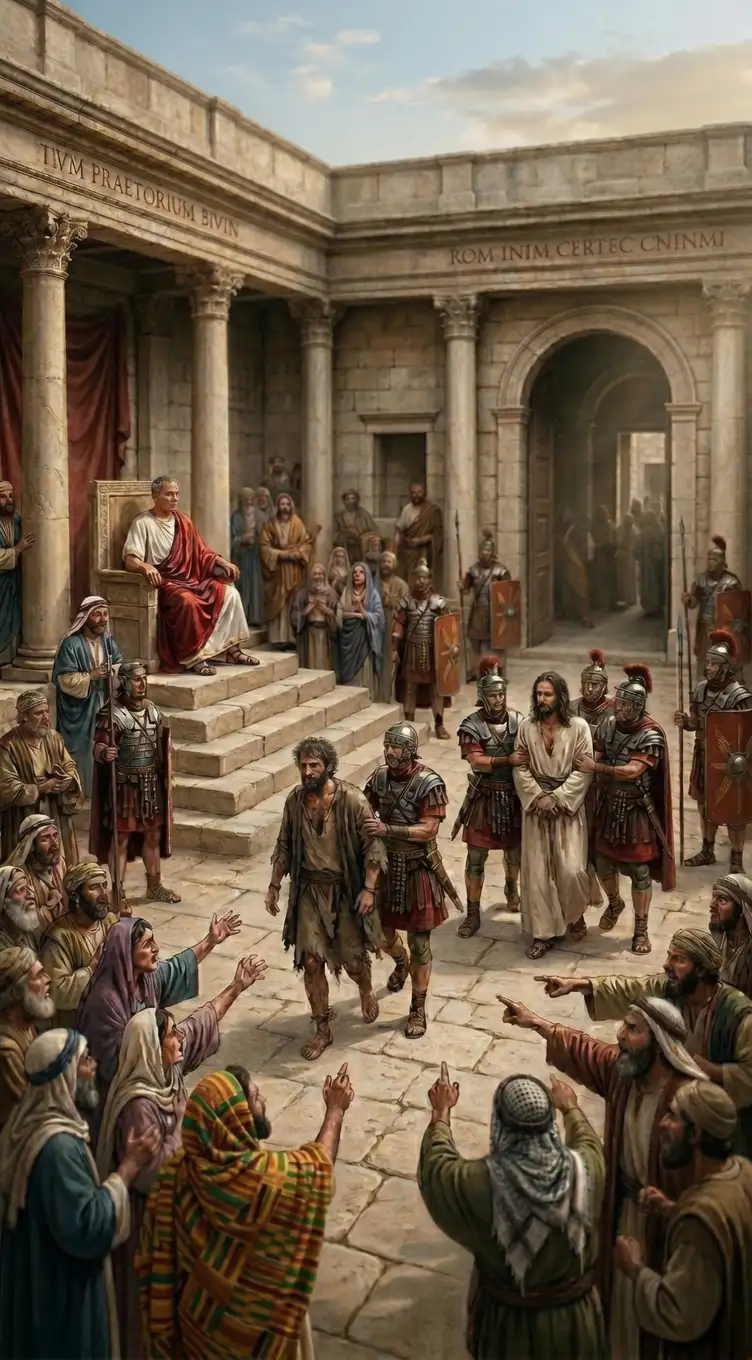 The parallel is unmistakable. Just as the two goats of the Day of Atonement stood before the high priest — one to die, one to go free — so two men named Jesus stood before the governor. One would be slaughtered. One would be released into the wilderness of the world.
Barabbas walked out of that courtyard a free man. He had done nothing to earn his freedom. He had not repented. He had not paid restitution. He simply benefited from the substitution that took place. Another man took the punishment that was rightfully his.
Jesus, the true Son of the Father, was led away to be crucified. He bore the sins of many. He was pierced for transgressions that were not His own. He was crushed under the weight of guilt that belonged to others. In that moment, the ancient ritual found its perfect fulfillment. The sacrificial goat and the scapegoat were both embodied in one Person — the Lamb of God who takes away the sin of the world.
We Are All Barabbas
This is the heart of the gospel. Every person who has ever lived stands in the place of Barabbas. We are guilty. We have rebelled against God. We have chosen our own way. We deserve the sentence of death. Yet the true Son of the Father stepped forward and took our place.
Jesus did not die because He was guilty. He died because we were guilty. He became the sacrificial offering whose blood covers sin. He became the scapegoat who carried our iniquities far away. On the cross, He was both goats at once — the blood that atones and the burden-bearer who removes sin from us forever.
Because He died, we go free. Not because we are innocent. Not because we have earned it. But because the Father accepted the perfect substitute. The innocent Son was condemned so that guilty sons and daughters could be released.
This is why the story of Barabbas is not just an interesting historical detail. It is a living picture of what happened to every believer at the cross. We were the ones who should have been led away to die. Instead, we walk free because Another took our place.
The Fullness of What Jesus Accomplished
The Day of Atonement required two goats because no single animal could fully picture what Christ would do. The blood had to be shed, and the sin had to be removed. On the cross, Jesus did both in one act. His blood was poured out as the perfect sin offering. His death carried away the guilt of all who would believe in Him.
This is why the writer of Hebrews says that Christ did not enter by means of the blood of goats and calves, but He entered the Most Holy Place once for all by His own blood, having obtained eternal redemption (Hebrews 9:12). The annual ritual was a shadow. The cross was the substance.
Because of what Jesus did, there is no longer any need for repeated sacrifices. The work is finished. The blood has been applied. The sin has been carried away. Those who trust in Him are no longer under condemnation. They are free — not because they are righteous in themselves, but because the righteous One died in their place and rose again.
Living as Those Who Were Set Free
Understanding this truth changes how we live. We are not Barabbas trying to earn our freedom. We are Barabbas who has already been released. The criminal who deserved death has been declared righteous because of Another’s sacrifice.
This produces deep humility. We did not choose the right side. We were the guilty ones who cried out for the wrong man to be released. Yet mercy triumphed over judgment. Grace reached into the courtroom of our lives and set us free.
It also produces deep gratitude. Every day we walk in freedom is a day we did not deserve. Every breath is a gift purchased by the blood of the true Son of the Father. We live as those who have been rescued from the sentence we justly deserved.
Finally, it produces a desire to tell others. The same substitution that set us free is available to every person who will turn from their sin and trust in Jesus. The cross still speaks: there is a Lamb who was slain, and there is a scapegoat who carried our sins away. Both are fulfilled in Christ alone.
The Only Safe Place to Stand
At the end of the day, every person must answer the same question the crowd faced: Which Jesus will you choose? The one who offers temporary freedom through rebellion, or the One who offers eternal freedom through His own death?
Barabbas walked away from that courtyard a free man, but he still needed a Savior. The true freedom he experienced that day was only a shadow of the freedom Jesus offers to all who believe. The cross is the place where guilty men and women are set free — not by chance, not by popular vote, but by the deliberate, loving choice of the Son of God to take our place.
May we never lose the wonder of this truth: One Jesus was crucified so that we — the guilty — could go free. That is the heart of the atonement. That is the message of the two goats. That is the gospel.