The Woman Who Touched the Fringe: Healing in the Wings of the Messiah
A Desperate, Silent Act of Faith
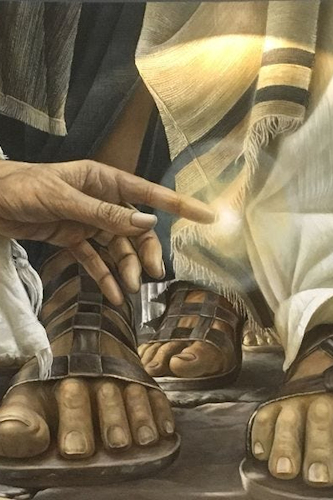 For twelve agonizing years she had lived with constant bleeding — a condition that made her ceremonially unclean according to Leviticus 15:25–27. Under Jewish law, she could not enter the temple, touch others without making them unclean, or even sit on the same seat as others. She was socially invisible, spiritually isolated, and financially ruined after spending everything on physicians who could not help her. Yet the rumors reached her: a teacher from Galilee was healing the sick, raising the dead, and proclaiming the kingdom of God. Something stirred in her heart. She believed the ancient prophecies. She believed He was the promised Messiah. So she pushed through the pressing crowd — risking public shame if discovered — and reached out to touch the very edge of His robe. The moment her fingers brushed the fringe, the flow of blood ceased. She felt healing power surge through her body (Mark 5:29).
Jesus felt it too. He stopped, turned, and asked, “Who touched me?” (Mark 5:30). The disciples were confused — the crowd was crushing in on Him — but Jesus knew power had gone out from Him. The woman came trembling, fell at His feet, and told the whole truth. In front of everyone, Jesus looked at her and said the words that forever changed her status: “Daughter, your faith has made you well; go in peace” (Luke 8:48 AKJV). She was no longer “the woman with the issue of blood.” She was called “daughter” by the Messiah Himself — publicly restored, healed, and honored.
"But unto you that fear my name shall the Sun of righteousness arise with healing in his wings..." — Malachi 4:2 (AKJV)
The Prophecy of Malachi 4:2 – Healing in His Wings
 The Hebrew word translated “wings” in Malachi 4:2 is kanaf (כָּנָף), which means “wing,” “edge,” “border,” or “corner.” In Jewish thought, this verse was a clear messianic promise: the “Sun of Righteousness” (the coming Messiah) would rise with healing in His kanaf. But what did that mean practically?
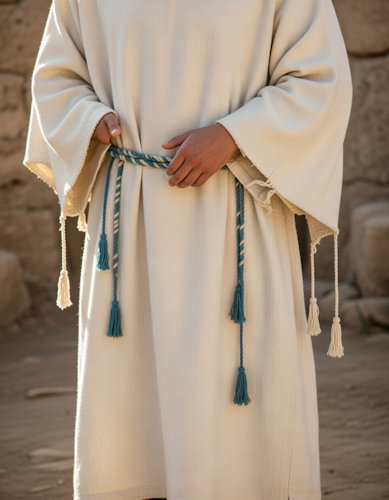
Jewish men wore a four-cornered outer garment (tallit) with tzitzit (fringes/tassels) attached to each corner in obedience to Numbers 15:37–40 and Deuteronomy 22:12. The tzitzit were blue cords and white threads, serving as constant reminders of God’s commandments. By the Second Temple period, rabbis explicitly linked Malachi 4:2 to these tzitzit: healing would come from the Messiah’s “wings” — the fringes on the corners of His robe. The woman knew this prophecy. She didn’t reach for Jesus’ hand, arm, or sleeve. She deliberately touched the fringe (Greek: kraspedon, meaning border/hem/tassel/tzitzit) — the very place Scripture said the Messiah’s healing would reside.
When she touched it, the prophecy came alive. Healing flowed from the “wings” of the Messiah because she believed He was the Sun of Righteousness. Jesus’ immediate response — feeling power leave Him, seeking her out, and publicly declaring her faith — confirms the moment. She touched the prophetic point, and Malachi’s promise was fulfilled in real time.
This single act bridges the Old and New Testaments. The last verse of the prophets (Malachi 4:2) is fulfilled in one of the first recorded healings in Matthew’s Gospel. The woman touched the hem — and the Sun of Righteousness rose with healing in His wings.
Theological Depth: Faith, Uncleanness, and Restoration
- Faith overcomes ritual law: She was unclean; touching Jesus should have made Him unclean (Leviticus 15:19–27). Instead, His holiness flowed into her, reversing the direction of uncleanness. This foreshadows the cross: Jesus takes our impurity so we can be cleansed (Isaiah 53:4–6; 1 Peter 2:24).
- Public restoration: Jesus calls her “daughter” and sends her in peace — publicly declaring her healed and socially re-included. No longer hidden or shamed, she is honored before the crowd (Mark 5:33–34).
- Power flows from Jesus: The phrase “power had gone out from him” (Mark 5:30) is unique — it shows the personal cost of miracles. It points forward to the greater cost of the cross, where all healing and salvation flow from His sacrifice.
- Application for today: We “touch the hem” by faith in the crucified and risen Jesus. No physical garment is needed — only trust in the One who wore it. His “wings” still bring healing: spiritual forgiveness, emotional restoration, and one day full physical healing in the resurrection (Revelation 22:2).
- The bridge to Malachi: The woman’s story shows how the Old Testament’s final promise is fulfilled in Christ. Malachi ends with hope — the Sun of Righteousness will rise with healing. She touched that hope, and it became reality. We touch it today through faith in Him.