Why Didn’t Jesus Correct Satan’s Claim About Owning the World’s Kingdoms?
The Temptation and Satan’s Bold Claim
 In the wilderness, after forty days of fasting, Satan takes Jesus to a high mountain and shows Him "all the kingdoms of the world and their splendor" (Matthew 4:8). He then makes a stunning offer:
“I will give you all their authority and splendor; it has been given to me, and I can give it to anyone I want to.” — Luke 4:6 (NIV)
Remarkably, Jesus does not dispute or correct the claim. He does not say, “You don’t own anything” or “The world belongs to God alone.” Instead, He responds:
“Worship the Lord your God and serve him only.” — Luke 4:8 (NIV)
Why didn’t Jesus challenge Satan’s assertion? The answer lies in the sobering reality of the present age: Satan does have real, though temporary and limited, authority over the world’s systems in their fallen state. Jesus’ silence was not agreement — it was recognition of a grim but temporary truth.
Satan’s Real but Temporary Authority
Scripture repeatedly describes Satan as having real (though limited and temporary) authority over the world in its current fallen condition:
- Jesus Himself called Satan “the prince of this world” (John 12:31; John 14:30; John 16:11).
- Paul called him “the ruler of the kingdom of the air, the spirit who is now at work in those who are disobedient” (Ephesians 2:2).
- John wrote, “the whole world is under the control of the evil one” (1 John 5:19).
- Paul also refers to Satan as “the god of this age” who blinds the minds of unbelievers (2 Corinthians 4:4).
- Jesus acknowledges that Satan has a “domain” from which he is being cast out through the cross (John 12:31).
After Adam’s sin, humanity forfeited the dominion God originally gave us (Genesis 1:28; Psalm 8:3–8). Satan gained real influence—not absolute ownership, but significant control over the systems, structures, and powers of this present age. Jesus’ silence on the claim was not agreement in principle but recognition of the temporary reality Satan could legitimately offer. To dispute it outright would have been inaccurate in the current order of things.
The Temptation Was Real—and Jesus’ Perfect Obedience
Satan’s offer was a genuine shortcut: authority over the kingdoms without the suffering of the cross. If Jesus had accepted, He could have ruled immediately—without Calvary, without death, without the full payment for sin. But the price was idolatry: worshiping Satan instead of God alone. Jesus refused because obedience to the Father’s will and Scripture was non-negotiable:
“Worship the Lord your God and serve him only.” — Luke 4:8 (NIV)
By going to the cross, Jesus secured true and eternal authority:
“All authority in heaven and on earth has been given to me.” — Matthew 28:18 (NIV)
The temptation was real. The offer was legitimate within the fallen order. Jesus’ refusal was not because Satan had no authority — it was because Jesus would not take the shortcut. He chose obedience, suffering, and the cross to redeem the world, not rule it prematurely on Satan’s terms.
The Cosmic Legal Framework: From Eden to the Cross
In ancient Israel and the Near East, important legal documents—especially property deeds—were prepared in two versions for security and verification:
- Sealed copy: Rolled up, sealed with wax/clay (impressed with signet rings), and stored safely. This was the official, tamper-proof archive copy.
- Open copy: Left unsealed for public reading and reference.
This double-document practice is described in Jeremiah 32:10–14, where Jeremiah buys a field and receives both the sealed and unsealed copies, placing them in a jar for preservation. Many such deeds were also written on both sides (opisthograph) to include full terms, conditions, witnesses, curses, and blessings.
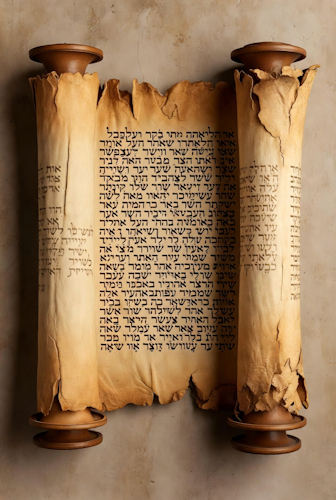
This ancient custom directly illuminates the scroll in Revelation 5:1:
“Then I saw in the right hand of him who sat on the throne a scroll with writing on both sides and sealed with seven seals.” — Revelation 5:1 (NIV)
The seven-sealed scroll represents the **title deed to the earth**—originally given to Adam (Genesis 1:28; Psalm 8:3–8), forfeited through sin, temporarily under Satan’s influence (Luke 4:6; Ephesians 2:2), and preserved by God until the rightful redeemer could claim it.
No one in heaven or earth was “worthy” to open it (Revelation 5:2–4)—no creature could legally redeem what was lost. Only one person could:
- The Kinsman-Redeemer (Hebrew go'el): In Old Testament law, a near relative (kinsman) could redeem land or people lost to debt or slavery (Leviticus 25:25–28; Ruth 4). The redeemer had to be a blood relative, willing, and able to pay the price. Jesus, as fully human and fully God, became our “near kinsman” (Hebrews 2:14–17), paying the redemption price with His own blood.
- The Last Adam: Paul calls Jesus “the last Adam” (1 Corinthians 15:45) and “the second man” (1 Corinthians 15:47). The first Adam lost dominion through disobedience; the Last Adam (Jesus) regained it through perfect obedience, even to death on the cross (Romans 5:12–19; Philippians 2:8). Where Adam failed, Jesus succeeded—reversing the curse and reclaiming creation.
Only the Lamb—our Kinsman-Redeemer and Last Adam—is worthy to break the seals (Revelation 5:5–9). When He does, He executes the judgments and reclaims full possession of the world (Revelation 11:15: “The kingdom of the world has become the kingdom of our Lord and of his Messiah”).
Satan’s offer was real but illegitimate and temporary. Christ’s obedience through the cross made Him the true, eternal Owner—fulfilling the redemption deed that Satan could never claim.
Why This Matters: Theological Depth and Modern Insight
 Jesus’ refusal to correct Satan’s claim is not a sign of weakness or agreement — it is a sign of perfect submission to the Father’s redemptive plan. By rejecting the shortcut, Jesus chose the cross — the only way to truly break Satan’s power, redeem the title deed, and establish eternal kingdom authority.
For us today, this passage reminds us that the world’s systems — governments, economies, media, culture — are still under temporary satanic influence (Ephesians 6:12). We are not to be surprised or despairing when evil appears to rule. Nor are we to seize power through compromise or shortcuts. Jesus shows us the path: obedience, suffering, and trust in the Father’s timing.
The temptation in the wilderness foreshadows the cross and resurrection. Satan offered the kingdoms without the cross; Jesus took the cross to reclaim the kingdoms. The same choice faces every believer: will we seek influence through compromise, or through faithfulness to the crucified and risen Lord? The answer determines whether we are building on sand or on the Rock (Matthew 7:24–27).
Jesus did not correct Satan because the time for full correction had not yet come. That time arrived at Calvary — and it will be finalized when the Lamb opens the scroll and declares, “The kingdom of the world has become the kingdom of our Lord and of his Messiah” (Revelation 11:15). Until then, we live in the tension — but with hope, knowing the true Owner is coming back.